Wednesday, December 14, 2011

Hydrolic Fracturing Causes Earthquakes?


Picture- Natural Gas Trucks in Youngstown

In Youngstown, Ohio, there had not been any seismic activity since the 18th century when the land was being settled. On March 17, there were two minor earthquakes. In the following eight months, there were several more. Nine earthquakes in a previously dormant area is very unusual. The epicenters were calculated to be at a natural gas disposal well.They claim that the waste water went too far down, unlocking ancient faults, which caused the earthquakes.


I think this is ridiculous. When coroporations dig wells for Natural Gas, they have to research the area thoroughly, so something like this doesn't happen. Maybe if they could get 100% confidence that it is the Gas companies' fault, the company could have some consequences. The companies are causing trouble everywhere, and the government isn't doing anything to stop it.

Question 1: Do you think it is the gas companies fault?
Question 2: Is there an equally effective alternative to natural gas mining?
Question 3: What can we do to help with problems like these?
By: Jarrett Hershman


Thursday, December 8, 2011

A New Energy Source?


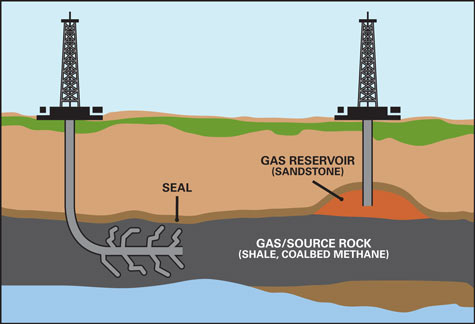
This picture is a diagram of how to get shale natural gas.


I read an article about a new type of fracking. Fracking for shale natural gas is a relatively new way to get energy. It has some benefits, some problems, and many question marks! Fracking for shale can make the United States completely on their own for getting energy. We have enough shale reserves to become independent from other countries. It is estimated that we have about 1.8 trillion barrels of shale gas, while Saudi Arabia has about 2.6 trillion of oil. Some major problems are water pollution, because it requires a lot of water, a high amount of emissions, and shale fracking is linked to earthquakes. Some important benefits are the jobs it will create, and that it is cleaner than most other fossil fuels.

I think it should be explored a little bit more, but it should not be relied on entirely. We can still use foreign natural gas, but shale should be used more to help reduce the pollution, and to create jobs for the economy.


Questions!!!!
1. Should we start using this method??
2. Why/why not?
3. Are there any other methods we should use??

Tuesday, December 6, 2011

Biofuels Worse Than Fossil Fuels

Ethanol, which comes from corn, can reduce toxic emissions by 50%... But Is it worth it?
"Biofuels worse than fossil fuels, says expert" by Ethan A. Huff http://www.naturalnews.com/030549_biofuels_fossil_fuels.html
Biofuels are becoming more and more popular in the race to stop foreign oil dependency. However, Andreas Spath, PhD, an expert in the field of geochemistry, says that biofuel is worse for the environment than fossil fuels. Fossil fuels will be depleted eventually, so it is important that renewable resources are used as much as possible. Biofuel simply relies on plants. So how, you ask, dis it worse for the environment? Well, to make the biofuel, you need crops. The get the crops, you need to use fertilizer, and when it's time to harvest the crops, what does farmer Brown use? His big green tractor, of course, powered by none other than Mr. Fossil Fuel. Using crops for fuel actually increases food prices, too. U.S. corn production has been shifted away from food to ethanol fuel. A 2007 study showed that biofuel production releases twice as much
greenhouse gas as fossil fuels do.

Biofuel production should not stop, because fossil fuels will run out. The corn used for biofuels should be organic, so there is no fertilizer pollution, and should be harvested using the fuel itself to reduce emissions.
Should biofuel be invested in?
Can this problem be solved?
What do you think the deciscion will be?

Saturday, December 3, 2011

FOSSIL FUELS AND THEIR IMPACT ON THE ENVIRONMENT

Title of article: Fossil Fuels: How Do They Negatively Affect the Environment?

Author: not listed

Pulication: 2011

Picture/Article Link: http://www.greenenergychoice.com/green-guide/fossil-fuels.html


The question is, do fossil fuels have a negative or positive impact on the environment? The answer is that fossils fuels mainly have a negative impact. Fossil fuels are the largest gas emitters in the whole world and they give out 3/4 of all methane, carbon, and other greenhouse gas emissions. Electricity is produced by burning fossil fuels (coal and petroleum) at extremely high temperatures, but there is a major problem with that. When fossil fuels are burned, large amounts of pollutants are introduced into the air and even the water. The burning of fossil fuels has a huge impact on the environment because it causes an excessive amount of pollution which is horrible for the environment and for the organisms that live there. The major problem with this situation is that the atmosphere already naturally takes in a huge amount of greenhouse gases, but it holds up to 25% more of the sun's radiation. This all happens because of the yearly increases in greenhouse gas emissions.


Overall, I strongly believe that something should be done to limit the amount of fossil fuels being burned/used so then less amounts of pollutants will be distributed into the air and water. Even though the burning of fossil fuels is helpful because it produces electricity, it also distributes huge amounts of pollutants into the air and water. These pollutants affect everyone and everything in the environment in a harmful way. I know that if I lived in a community nearby where fossil fuels were burned, I would want to find a way to limit the usage of them because I would be the one that is getting harmfully afftected by the pollutannts in the air. In conclusion, fossil fuels have a negative impact on the environment.

Questions:


  1. Do you think people truly know how much of an impact fossil fuels have on the environment?


  2. What are some ways that YOU can come up with to limit the amount of fossil fuels being burned/used?


  3. Do you think this problem (involving the fossil fuels) will ever get better?

BY: TAYLOR SOLTYS

Sunday, October 30, 2011

Lead in Drinking Water?


Title of Article: Lead in DRinking Water
Author: United States Environmental Protection Agency
Date Last Updated: October 4, 2011
Link to the Article: http://water.epa.gov/drink/info/lead/index.cfm
Link to Picture:http://www.freshwatersystems.com/s-289-lead-in-water.aspx


Lead is a substance that is commonly used in household plumbing and water service lines. Lead is barely ever found in source water, but it does enter tap water through corrosion of plumbing materials. All homes are at risk of having lead in their water, but houses that were built before 1986 are the houses that are most likely to have lead pipes. The new houses are also at risk of having lead in their pipes. Even though these new houses are said to have "lead-free" plumbing, they still can have up to eight percent of lead in their plumbing. The most common way that lead is exposed to our drinking water is by the brass or chrome-plated brass faucets that allow an abundant amount of lead into the water. The problem with having lead in our water is that lead can cause many health effects. The health effects for babies and children that drink above the action level of lead are having delays in their mental and physical development. The effects for adults that drink above the action level of lead are having an increse in blood pressure. Adults that drink the water for many years can accumulate kidney problems.

I do not have a strong opinion on this topic. Since that there is only up to 8 percent of lead in house pipes, it should not be a big concern for people. If the percentage of lead in house pipes increases rapidly, then we should have a concern. I have been drinking my tap water for 14 years and I have never experienced life threatening effects. Also, my house is a newer house, therefore the percentage of lead in my tap water is lower than the percentage of tap water in a house that was built before 1986.

Questions:


  1. Do you think the percentage of lead in the pipes will increase over the years to come?

  2. Are you concerned if the pipes in your house contain lead?

  3. Do you think there is anything we can do to limit the amount of lead in our tap water?


By: TAYLOR SOLTYS

Clean Water At a High Price!!

http://www.huffingtonpost.com/jennifer-schwab/air-and-water-a-right-or_b_264733.html

The pictue on the right shows an African Child trying to get drinking water.

I found out in this article that there are some water companies in small, developing countries like Bolivia, Honduras, and Nicaragua that are charging high sums of money for clean drinking water. Drinking water can be hard to get in these countries, but at least it was free. Now, these companies are making it even harder for people without a lot of money to get drinking water.

I am shocked that companies would do this to such poor countries. They ar taking advantage of countries that already need more water, and are making it harder to get. These companies say that they are trying to help these countries. But it is obvious that it is just for a big profit.

1. Do you think it is right for these companies to charge for clean water?? why??

2.What would you do to prevent these companies from charging such high fees?

3.Why do you think these companies are doing what they are doing??

By: Jordan Murray :D

P.S. The picture wont post so the URL is http://www.gracededieu.org/water.html

Wednesday, October 26, 2011

Groundwater!

The image to the right shows the results of aquifer depletion in India. The loss of groundwater is threatening their agriculture.
http://www.newscientist.com/article/mg21128314.700-groundwater-greed-driving-sea-level-rises.html

The sea level is slowly rising. The melting of glaciers and other ice caps are increasing the level of the ocean. It is virtually impossible to notice, but the pumping of water from underground aquifers to the surface is also contributing to this problem. Few scientists believe in groundwater affecting the level of the ocean, but Leonard Konikow of the United States Geological Survey has evidence to prove it. Konikow measured how much water had ended up in the oceans by studying aquifers, and he estimated that about 4500 cubic kilometres of water was originally groundwater from the years 1900 and 2008. That means it only contributed about 1.26 centimeters to the overall rise in sea level. Nobody is sure what the future holds when it comes to groundwater, but some countries are cutting back on aquifer use.

I don't believe it is necessary to cut back on aquifer use. The amount of groundwater that contributes to rising of the sea level is little enough that if we use the groundwater carefully, and it doesn't end up in oceans, we can decline the rapidly increasing water level. We don't need to go to extreme measures such as using your own rain collecting source... Simple things like taking shorter showers and not leaving the sink running can help. We don't need to work harder, we need to work smarter!

Do you think the water level will increase or decrease in the next 5 years?
What can you and your family do to conserve groundwater?
What would happen if our groundwater comes near depletion in the future?
-John

Tuesday, October 25, 2011

THE AMAZON IS BEING DESTORYED!?!?!?!?

Bolivia has recently decided to build a 185 mile long highway through the Amazon rainforest. Thousands of protestors have been marching, trying to stop this awful idea from occuring. It will destory biodiversity and destroy so many animals' habitat. Brazil has made a $332 million loan to bolivia so they can create this highway that goes to their capital. Luckily enough, the Bolivian president decided to obey the will of his peopl and cancel the project. It would have greatly hurt the Amazon as a whole.
I am very happy that this project was canceled. It would have greatly hurt the rainforest and all of it's animals. It is very inspiring that the people of Bolivia took a stand and defended the rainforest. Most people would just let it happen without a second thought, but they stood up for what is right. The Earth is in no shape to have one of its most diverse places be fragmented so.

1. How do you feel about the idea of a high way going through the Amazon?
2. If you were a Bolivian, would you stand up against your government?
3. How do you think it would affect the animals?

Sunday, September 25, 2011

Alaska Forest


Above, is a picture of a forest growing in Alaska. I don't know why it is so big.


I found it amazing that there is a forest growing in Alaska. Usually when I think of Alaska I think of snow. But now, due to climate changes, it is becoming a forest. According to scientist research, the currently growing forests are going to become Alaska's new Biome-type! I find it incredibly hard to imagine Alaska without snow, and I've never even been there. It is incredible to think that a Biome could change! I had no idea it was possible. This change will greatly affect some of the organisms leaving in the Alaska area. This will especially have a big impact on humans. Something that I also found interesting is that these types of forests are drought-stressed, which means that they dont get enough water. I find this really interesting because of all the snow in Alaska

Questions:
1. Why do you think this is happening?
2. Is this good or bad for Alaska?
3. (If you answered bad to #2) How can this be prevented?
4. (If you answered good to #2) Why did you answer good?

Wednesday, September 21, 2011

Dolphins?!?!?!?!?!?!?

Picture- This is a picture of the new species of dolphin found in Australia


Summary:Recently in Australia, they have discovered a rare new type of dolphin. It is called Tursiops australis. There are only 150 of them believed to be in existence. There are only a couple of places along the coast of Australia in which they inhabit. People had thought they were bottlenose dolphins before, but they were actually an entire different species. They were living right under the Australian people's noses the whole time. They have only found 3 new dolphin species since 1800! It definitely helps scientists get a more accurate biodiversity for the coast of Australia.

Reflection: I think it is very cool that they have found a new species. It is very rare to find a new species of dolphin. I think it would be awesome to be able to name your own species. If I found a species of dolphins, I would name it Jarretticus dolphinius

Questions:
1.How would you feel if you discovered a brand new species?
2. What do you think about how millions of unknown species could be living right by us and we have no idea of it?
3. If you discovered a new species, what would you name it?

Monday, September 19, 2011

Biodiversity

Current Events: #4 Biodiversity


This graphic shows the relationship among the amount of organsims in a species, that make up an ecosystem. This picture really gets the message across that every single species plays an important role in an ecosystem. http://anaphi.wordpress.com/2010/08/03/biodiversity/

No matter size or gender, each and every organism plays a huge role that makes up our ecosystem. Because of the severe climate changes that are happening world wide, the biodiversity of species are rapidly decreasing. Biodiversity is extremely affected by this climate change for several reasons. Since that the climate change is too harsh for animals to live in, species are beginning to die off. Once one species dies, it affects another, and then that species affects another, and so on. For example, if plants can't live, then animals have limited amounts of food and will die sooner, which leaves humans nothing to hunt. This climate change is happening world wide, from all the way in the Artic where the ice is melting and polar bears & penguins are becoming extinct. It is also affecting the Coral Reefs which are dying. Due to the Coral Reefs dying, large amounts of fish are decreasing. "We are shown pictures and facts about global warming everyday and some are making an effort to stop it but not all." People don't realize how important this problem with the climate change really is. It is effecting the whole biodiversity of species. Even small things like recycling and using more energy-safe products can help save our ecosystem.


I was surprised how much something as little as a climate change could have such a huge impact on an ecosystem. I never really cared nor wondered about the extinction of species in our ecosystem. Now I know how important it is to do anything we can to prevent the extinction of other species in our ecosystem.


Questions:


  1. Why do you think only some people are making an effort to stop global warming?

  2. What species do you think would have the highest impact on our ecosystem if it were to become extinct?

  3. What are some other ways ( that are not listed above) you can help stop global warming ?


Thursday, September 15, 2011

Lt. Col. Daniel Schmitt adresses guests at a dinner held by local leader, Mohammad Razul, to commemerate the deaths of his brother and father. Razul was one to stand up against insurgency in Helmand, Afghanistan.
Before coalition and Afghan forces began security operations in Helmand, few citizens stood up to the oppressive insurgent force. The community supported the insurgency, until Mohammad Razul an dhis family decided they wanted to live differently. The insurgents attempted to murder Razul's family at a mosque, but upon returning from retrieving weapons to fight back, his father and brother were killed. Now, one year later from the day,security has increased in the city. The 2nd Marine Division frequently led patrols through the city. Gradually the ANA (Afghan National Army) began leading from the front. The ANA is now leading patrols with little menotring from the Marines. "Since the Afghan Army and Americans came, a lot has changed. We can Patrol through the city and there are no IEDs and no ambushes. No insurgents. The security is much better than it was a year ago," said Sgt. Ahmad Marjani, an Afghan police officer and resident. Hopefully, the Afghan forces will be able to provide security without US assistance.
With the help of The United States Marine Corps, Afghan Forces, and local residents, Mohammad Razul managed to displace insurgency in the community.
Questions:
What do you think is the most effective way for Afghanis to rid a city of insurgents?
Why do you think most Afghani residents decide to do nothing about insurgency?
If every insurgent-occupied community handled their situation like this, how much longer would this war be going on?
-john :D

Tuesday, September 13, 2011

CORAL REEFS! :)


This is a picture of a bleached Coral Reef near Thailand.

SUMMARY

The destruction of Coral Reefs may not seem like a huge deal compared to other pollution, but it is incredibly important. There was a study called Reefs At Risk that talked about the destruction of the world's coral reefs. That study was done in 1998 and it was discovered that 61% of Coral Reefs were in danger. The study was redone ten years later and at this point 75% of Coral Reefs were in danger. Coral Reefs play a major part in some countries survival. In small islands that are surrounded by Coral Reefs they are needed to protect from waves and storms, and they play a major part in the tourism industry, as well as a source of food and even medicine. Without Coral Reefs these islands would greatly struggle. Coral Reefs are very important and we need to protect them!

OPINION/REFLECTION
I am really surprised about some things I have learned from the blog. I had no idea that 75% of Coral Reefs are in danger of destruction. I didn't realize that Coral Reefs were so important to the world, and that they needed to be protected.

QUESTIONS
What are some wasy that YOU can help save Coral Reefs?
Why do you think Coral Reefs dont recieve very much media attention?
How could this problem have been prevented?

That was my blog! :D