Wednesday, December 14, 2011

Hydrolic Fracturing Causes Earthquakes?


Picture- Natural Gas Trucks in Youngstown

In Youngstown, Ohio, there had not been any seismic activity since the 18th century when the land was being settled. On March 17, there were two minor earthquakes. In the following eight months, there were several more. Nine earthquakes in a previously dormant area is very unusual. The epicenters were calculated to be at a natural gas disposal well.They claim that the waste water went too far down, unlocking ancient faults, which caused the earthquakes.


I think this is ridiculous. When coroporations dig wells for Natural Gas, they have to research the area thoroughly, so something like this doesn't happen. Maybe if they could get 100% confidence that it is the Gas companies' fault, the company could have some consequences. The companies are causing trouble everywhere, and the government isn't doing anything to stop it.

Question 1: Do you think it is the gas companies fault?
Question 2: Is there an equally effective alternative to natural gas mining?
Question 3: What can we do to help with problems like these?
By: Jarrett Hershman


Thursday, December 8, 2011

A New Energy Source?


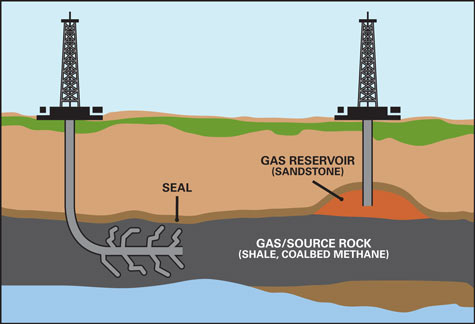
This picture is a diagram of how to get shale natural gas.


I read an article about a new type of fracking. Fracking for shale natural gas is a relatively new way to get energy. It has some benefits, some problems, and many question marks! Fracking for shale can make the United States completely on their own for getting energy. We have enough shale reserves to become independent from other countries. It is estimated that we have about 1.8 trillion barrels of shale gas, while Saudi Arabia has about 2.6 trillion of oil. Some major problems are water pollution, because it requires a lot of water, a high amount of emissions, and shale fracking is linked to earthquakes. Some important benefits are the jobs it will create, and that it is cleaner than most other fossil fuels.

I think it should be explored a little bit more, but it should not be relied on entirely. We can still use foreign natural gas, but shale should be used more to help reduce the pollution, and to create jobs for the economy.


Questions!!!!
1. Should we start using this method??
2. Why/why not?
3. Are there any other methods we should use??

Tuesday, December 6, 2011

Biofuels Worse Than Fossil Fuels

Ethanol, which comes from corn, can reduce toxic emissions by 50%... But Is it worth it?
"Biofuels worse than fossil fuels, says expert" by Ethan A. Huff http://www.naturalnews.com/030549_biofuels_fossil_fuels.html
Biofuels are becoming more and more popular in the race to stop foreign oil dependency. However, Andreas Spath, PhD, an expert in the field of geochemistry, says that biofuel is worse for the environment than fossil fuels. Fossil fuels will be depleted eventually, so it is important that renewable resources are used as much as possible. Biofuel simply relies on plants. So how, you ask, dis it worse for the environment? Well, to make the biofuel, you need crops. The get the crops, you need to use fertilizer, and when it's time to harvest the crops, what does farmer Brown use? His big green tractor, of course, powered by none other than Mr. Fossil Fuel. Using crops for fuel actually increases food prices, too. U.S. corn production has been shifted away from food to ethanol fuel. A 2007 study showed that biofuel production releases twice as much
greenhouse gas as fossil fuels do.

Biofuel production should not stop, because fossil fuels will run out. The corn used for biofuels should be organic, so there is no fertilizer pollution, and should be harvested using the fuel itself to reduce emissions.
Should biofuel be invested in?
Can this problem be solved?
What do you think the deciscion will be?

Saturday, December 3, 2011

FOSSIL FUELS AND THEIR IMPACT ON THE ENVIRONMENT

Title of article: Fossil Fuels: How Do They Negatively Affect the Environment?

Author: not listed

Pulication: 2011

Picture/Article Link: http://www.greenenergychoice.com/green-guide/fossil-fuels.html


The question is, do fossil fuels have a negative or positive impact on the environment? The answer is that fossils fuels mainly have a negative impact. Fossil fuels are the largest gas emitters in the whole world and they give out 3/4 of all methane, carbon, and other greenhouse gas emissions. Electricity is produced by burning fossil fuels (coal and petroleum) at extremely high temperatures, but there is a major problem with that. When fossil fuels are burned, large amounts of pollutants are introduced into the air and even the water. The burning of fossil fuels has a huge impact on the environment because it causes an excessive amount of pollution which is horrible for the environment and for the organisms that live there. The major problem with this situation is that the atmosphere already naturally takes in a huge amount of greenhouse gases, but it holds up to 25% more of the sun's radiation. This all happens because of the yearly increases in greenhouse gas emissions.


Overall, I strongly believe that something should be done to limit the amount of fossil fuels being burned/used so then less amounts of pollutants will be distributed into the air and water. Even though the burning of fossil fuels is helpful because it produces electricity, it also distributes huge amounts of pollutants into the air and water. These pollutants affect everyone and everything in the environment in a harmful way. I know that if I lived in a community nearby where fossil fuels were burned, I would want to find a way to limit the usage of them because I would be the one that is getting harmfully afftected by the pollutannts in the air. In conclusion, fossil fuels have a negative impact on the environment.

Questions:


  1. Do you think people truly know how much of an impact fossil fuels have on the environment?


  2. What are some ways that YOU can come up with to limit the amount of fossil fuels being burned/used?


  3. Do you think this problem (involving the fossil fuels) will ever get better?

BY: TAYLOR SOLTYS